

Note: This blog is based on insights and discussions from a webinar I recently attended on waste reduction and incineration.
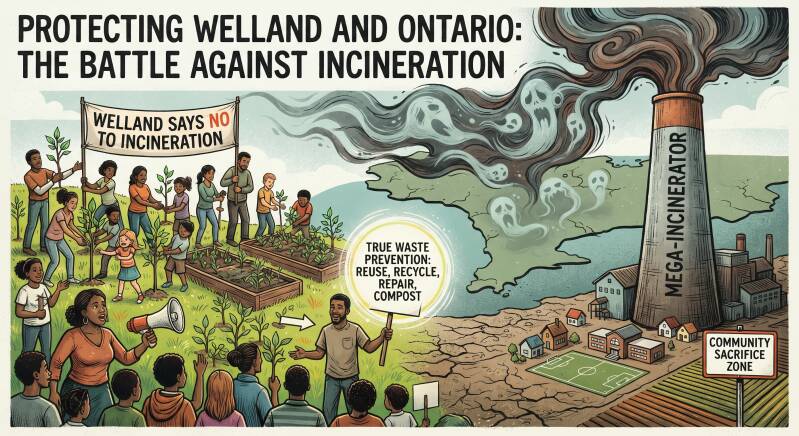
As municipalities across Ontario grapple with mounting waste streams, communities are increasingly targeted as convenient sites for high-capacity waste-burning facilities. While the proposed massive expansion of the Emerald incinerator in Brampton has galvanized regional resistance, the broader policy landscape under provincial measures signals a growing threat to communities across the province—including Niagara and Welland.
Protecting our local communities requires a clear understanding of the webinar's key takeaways, the true pros and cons of waste incineration, the mechanics of industry "sacrifice zones," and proactive steps municipalities like Welland can take to shield our environment and public health.
Webinar Insights: Myths, Realities, and Policy Context
A live audience poll conducted during the webinar highlighted common misconceptions surrounding waste-to-energy facilities:
- Burning vs. Landfilling: 89% of participants correctly identified that burning waste is not better than landfilling it.
- Pollution Control Filters: While 25% believed new incinerators have filters that prevent all pollution, experts emphasized that no filter can capture the entirety of harmful emissions.
- Clean Energy Claims: 80% recognized that energy derived from burning waste is far from "clean," ranking it as one of the dirtiest energy sources—well behind Ontario’s existing renewables.
The Blue Box Program and Flexible Plastics
Ontario's waste crisis is significantly driven by commercial packaging practices rather than individual household actions. While the province established producer-responsibility rules in 2021 to shift the financial and operational burden of the Blue Box program onto corporations, producers are pushing back against rising costs.
A major battleground is flexible plastics (such as wrappers, pouches, nets, and bags). Producers currently place 80,000 tonnes of flexible plastic packaging on the residential market annually—one-third more than the volume of glass packaging. Because these materials gum up sorting machinery and lack viable recycling pathways, producers are attempting to shed responsibility for them. Weakening these rules risks leaving households with no option but disposal, while incentivizing companies to produce even more unrecyclable packaging.
Pros and Cons of Waste Incineration Facilities
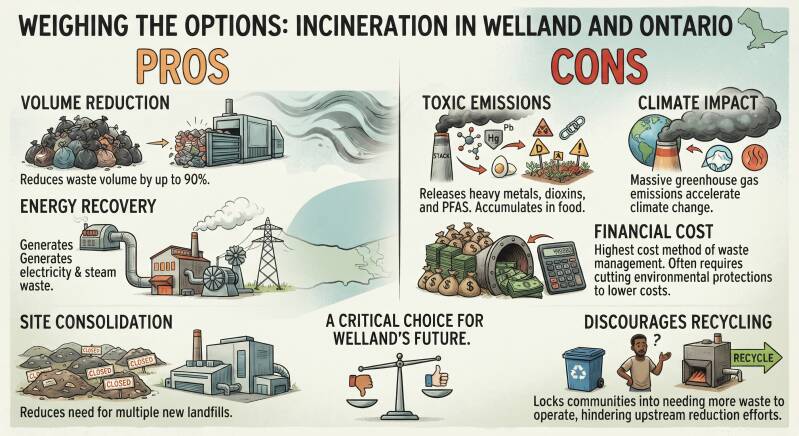
Proponents often market waste-to-energy incinerators as modern technological solutions to landfill capacity issues. However, a rigorous look at the trade-offs reveals significant environmental, social, and economic downsides.
Potential Claims & Industry "Pros"
- Volume Reduction: Incineration reduces the physical volume of waste by roughly 80% to 90%, which proponents argue relieves pressure on traditional landfill space.
- Energy Recovery: Facilities capture heat to generate electricity or steam, which is sometimes touted as a form of waste-to-energy recovery.
- Site Consolidation: Expanding existing facilities is often framed by developers as more efficient than permitting entirely new greenfield sites.
Realities and Severe "Cons"
- Persistent Toxic Emissions: No smokestack filter can capture 100% of pollutants. Incinerators release heavy metals (such as mercury, lead, and cadmium), dioxins, and PFAS that do not break down; instead, they accumulate in the surrounding ecosystem (such as contaminating local agricultural soils and food sources). European studies near high-standard incinerators even advise residents against consuming eggs produced within a 3-kilometer radius due to high dioxin accumulation.
- Financial and Economic Traps: Incineration is universally recognized as the most expensive method of waste management. To cut costs, operators frequently sacrifice crucial environmental protections and advanced pollution scrubbers.
- Climate Change Acceleration: Burning waste releases massive amounts of greenhouse gases, contributing to global warming at a rate higher than many alternative management strategies.
- Discouraging Upstream Reduction: Building massive incinerators locks municipalities into a multi-decade cycle requiring a continuous supply of garbage, actively disincentivizing waste reduction, reuse, and recycling.
Why Communities Like Welland Must Stay Vigilant
Incinerator proponents routinely rely on a well-documented playbook: selecting working-class areas, industrial corridors, or municipalities with lower regional political organization to establish or expand "sacrifice zones".
While the Brampton proposal targets a site near residential zones and children's sports fields, the implications of provincial legislation (such as Bill 140) mean that no municipality in Ontario is entirely immune from pressure to accept waste infrastructure. For a growing, vibrant community like Welland—steeped in agricultural roots, rich green spaces, and active local stewardship—guarding against industrial waste-burning proposals is vital to protecting our public health, property values, and local waterways.
Action Plan: How Welland and Local Communities Can Protect Themselves
To ensure Welland remains protected against unwanted waste-burning facilities and landfill pressures, residents, community leaders, and municipal officials can take concrete action:
- Enforce Robust Municipal Bylaws and Official Plan Protections: Ensure Welland's municipal planning documents include strict zoning safeguards, comprehensive environmental impact assessments, and rigorous buffer requirements that categorically restrict waste-incineration facilities within or adjacent to residential and agricultural zones.
- Prioritize True Waste Prevention and Diversion:
- Maximize local green-bin organic diversion rates to reduce the sheer volume of organic material heading to disposal.
- Champion universal deposit-return systems for all beverage containers and support local refillable packaging models.
- Expand community repair networks, tool libraries, and textile reuse initiatives (similar to local Repair Cafés, such as laptop repair workshops converting older machines to run Linux) to keep goods in circulation.
- Demand Transparency and Independent Air Monitoring: Follow the lead of the Brampton Environmental Alliance by partnering with academic institutions (such as York University) to establish independent, publicly accessible air-quality and emissions monitoring stations that track heavy metals and dioxins rather than relying solely on infrequent, pre-announced corporate audits.
- Build Regional Coalitions: Form strong alliances across Niagara and surrounding regional municipalities. By organizing early and speaking with a unified voice, communities can successfully counter provincial overreach and stop industrial waste-burning projects before they gain traction.
- Engage Directly with Decision-Makers: Make your voice heard by contacting city councillors, regional chairs, and provincial MPPs. Demand strict provincial accountability, oppose weakening changes to the Blue Box program, and insist that corporate producers remain fully responsible for managing their packaging waste.

Add comment
Comments