

If you tuned into the two-and-a-half-hour YourTV Niagara (Cogeco) mayoral debate hosted by Anthony Luongo, you saw an eight-candidate field divided by political crosswinds, heated personal exchanges, and competing visions for Welland’s future.
Between 15 cited Integrity Commissioner complaints, finger-pointing over procedural failures, and candidates burning through wild cards to settle scores, the stage made one thing abundantly clear: City Hall has grown disconnected from everyday neighborhood realities.
At the same time, a structural shift is taking place just outside the spotlight. Under Ontario’s Better Regional Governance Act (Bill 100), Niagara Regional Council is being overhauled. Voters no longer elect separate regional councillors; instead, regional council is shrinking from over 30 members down to just 13—comprising Niagara’s 12 local mayors and a provincially appointed Regional Chair backed by "Strong Chair" veto powers.
Because the next Mayor of Welland will be our city's sole elected voice at that regional table, the local ward councillor’s job in Ward 1 has never been more critical. As your candidate for Welland City Council in Ward 1, here is a full breakdown of what happened on that debate stage, the regional shifts taking place, and why our neighborhoods need an independent, grounded voice at City Hall.
Part 1: Full Breakdown of the Mayoral Debate
Debate Overview & Format
- Moderator: Anthony Luongo
- Participants (8 Candidates): David Clow, Natasha Bergen, Graham Speck, Brandon Simon, April Jeffs, Pat Chiocchio, David McLeod, and Gary Graziani.
- Structure:
- 90-second opening statement.
- Alternating questions with 60-second responses.
- Four 30-second optional "Wild Card" rebuttals per candidate.
- 90-second closing statements in reverse order.
Key Debate Topics & Candidate Positions
- City Facilities in Poor Condition
- Context: A recent review found over 50% of Welland’s municipal facilities are in poor or very poor shape.
- Natasha Bergen: Advocated for an audit of all city-owned properties and a line-by-line budget review, emphasizing that "growth should pay for growth".
- Graham Speck: Noted the asset management report was a wake-up call to prioritize critical capital repairs to mitigate city liability.
- Brandon Simon: Criticized the city's $17.8M contribution to Niagara Health and developer subsidies, insisting Welland fix its "own home" first before regional spending.
- April Jeffs: Proposed a 100-day line-by-line value-for-money audit; cited retrofitting the arena during her time as Wainfleet mayor rather than costly demolitions.
- Pat Chiocchio: Acknowledged systemic poor planning and suggested increasing reserve contributions while aggressively applying for upper-tier government infrastructure grants.
- David McLeod: Supported phased funding through a 10-year asset management plan, comparing it to council’s restructuring of aging fire facilities.
- Gary Graziani: Emphasized evaluating whether underused facilities should be restored or divested.
- David Clow: Pushed for an independent forensic audit and blamed council candidates for approving developer charge reductions that push infrastructure costs onto homeowners.
- The Lock & Quay Mega-Development (4,500 Units)
- Graham Speck: Stated legal appeals make stopping private applications unrealistic; argued only large developers can afford to rehabilitate the overburdened canal lands.
- Brandon Simon: Questioned selling 152 acres of city land for $35M during a recession, noting Welland has already exceeded 2030 population targets.
- April Jeffs: Highlighted residents' concerns over storm drainage, flooding risks, and the inability of Quaker Road to absorb excessive density.
- Pat Chiocchio: Pushed for infrastructure-first planning so existing taxpayers are not forced to subsidize large development impacts.
- David McLeod: Emphasized upgrading regional trunk lines, local traffic capacity, and maintaining neighborhood integration.
- Gary Graziani: Questioned where the accompanying schools and community amenities would come from and whether units would genuinely be affordable.
- David Clow: Attacked the council for providing developer tax breaks and discounts on semi-detached development charges.
- Natasha Bergen: Stressed that development charge exemptions must never occur without identified alternative funding.
- Partnerships with Post-Secondary Institutions (Brock & Niagara College)
- Brandon Simon: Proposed property tax incentives for graduates opening local startups and 30% below-market student housing in the downtown core.
- April Jeffs: Outlined her current work at Brock University, advocating for expanding makerspaces and joint commercial ventures to retain talent.
- Pat Chiocchio: Highlighted utilizing Brock and Niagara College research, student talent, and workforce training programs for incoming industries.
- David McLeod: Cited Niagara College’s custom workforce training that helped land 450 jobs at the GE plant as a template for a downtown business launchpad.
- Gary Graziani: Stressed retaining graduates locally by expanding partnerships tied to Niagara College's new healthcare expansion.
- David Clow: Argued institutions are underutilized because council only focuses on industrial parks while letting the downtown decay.
- Graham Speck: Noted higher education drives municipal prosperity and praised campus expansions at both institutions.
- Homelessness, Mental Health, and Addictions
- April Jeffs: Committed to a 100-day task force involving EMS, regional police, and faith groups; advocated for supportive housing, detox beds, and expanded abstinence-based programs like Arid Recovery Homes.
- Pat Chiocchio: Supported a Housing First model with wraparound support modeled on the regional bridge housing and HART hub programs.
- David McLeod: Endorsed the provincially aligned Homelessness and Addiction Recovery Treatment (HART) hub framework connecting housing with social and clinical services.
- Gary Graziani: Declared his core mandate is securing "a bed for everyone" in need across shelters and housing.
- David Clow: Strongly criticized current harm reduction/needle distribution models; proposed a "Kid Map Safe Zone" with drug exclusion corridors and a 4-door triage system.
- Natasha Bergen: Recommended replicating supportive models from St. Thomas and Elgin County, expanding discretionary housing stability funding, and establishing cross-sector task forces.
- Graham Speck: Raised concerns about the location of the Ontario Road shelter near a school and urged a unified policy review with the mayors of Niagara Falls and St. Catharines.
- Brandon Simon: Proposed a 24-hour "work-to-live" transitional employment and housing model, alongside strict police enforcement of public drug consumption.
- Council Decorum, Leadership, and Integrity
- Pat Chiocchio: Emphasized being a team player and allowing structured, healthy debate in chambers.
- David McLeod: Highlighted his seven years as budget chair managing council friction; stated the mayor must set non-negotiable rules of order immediately.
- Gary Graziani: Supported utilizing Ontario’s Bill 9 and codes of conduct to enforce mutual respect and accountability.
- David Clow: Pointed out recurring Integrity Commissioner investigations involving sitting council members, accusing current leadership of failing to maintain standards.
- Natasha Bergen: Promoted a consensus-based leadership style focused on team collaboration.
- Graham Speck: Called for informal resolution dispute mechanisms and one-on-one mayoral meetings with ward councillors to prevent toxic chambers.
- Brandon Simon: Suggested strict enforcement of procedure rules without side-chatter, even proposing standard uniforms to minimize grandstanding.
- April Jeffs: Stated organizational culture starts at the top with mutual respect, checking egos, and understanding each councillor’s ward priorities.
- Downtown Revitalization & East Main Street
- David McLeod: Proposed dedicating economic development staff to the downtown core and creating a startup launchpad for graduates in empty storefronts.
- Gary Graziani & Graham Speck: Both advocated expanding Community Improvement Plan (CIP) financial incentives to encourage private property upgrades,.
- David Clow: Stated that downtown revitalization cannot happen until public drug use and safety concerns around the market square are eliminated.
- Natasha Bergen & April Jeffs: Called for enhanced street safety, streetscaping, cleaner sidewalks, and year-round programming to transform downtown into an experience,.
- Pat Chiocchio: Outlined an agreement with regional police to install a permanent downtown police substation/satellite office.
- Brandon Simon: Argued for private security on municipal properties and boosting local GDP per household to make extended business hours commercially viable.
- Municipal Assets, Sports Tourism, and Recreation
- Gary Graziani: Recalled Welland’s legacy as a championship sports hub and called for actively celebrating local athletes.
- David Clow: Proposed opening the canal for regulated personal watercraft, jet ski, and recreational boat access.
- Graham Speck: Outlined park investments across Ward 5, pool accessibility upgrades, and leveraging the North and South canal rowing courses.
- Brandon Simon: Proposed building a multi-thousand-seat stadium at Young Sportsplex, landing semi-pro soccer, and reviving senior AAA hockey (Allan Cup).
- April Jeffs: Prioritized replacing lost community amenities like a bowling alley, supporting the Welland Jackfish, and adding a winter skating loop to Merritt Island.
- Pat Chiocchio & David McLeod: Stressed treating the canal as an economic engine, updating the Parks & Rec Master Plan, and building a new multi-pad arena to host major tournaments,.
- Affordable Housing Tools & Housing Targets
- David Clow: Opposed chasing growth targets, advocating for immediate forensic audits and tax freezes.
- Natasha Bergen: Pointed to inclusionary zoning models (such as Burnaby, BC) and community bonus benefits to secure deeply affordable units.
- Graham Speck: Noted Welland's official plan is outdated (last passed in 2017) and argued traffic and infrastructure master plans must catch up before expanding density.
- Brandon Simon: Argued Welland already has lower purchase prices compared to neighboring cities and called for subsidies to renovate older century homes.
- April Jeffs & Pat Chiocchio: Supported density bonuses, expedited approvals, and partnerships with non-profits (such as church-led tiny home projects),.
- Gary Graziani: Emphasized securing federal/provincial housing grants, pointing out St. Catharines' recent funding as a benchmark.
- Business & Industrial Attraction
- Brandon Simon: Reiterated that commercial and retail chains follow resident spending power and higher GDP per household.
- Graham Speck & David McLeod: Promoted preparing serviced, shovel-ready municipal industrial land along rail and transit routes,.
- April Jeffs: Noted Welland's highway proximity (Hwy 406) makes it ideal for logistics and distribution hubs.
- Gary Graziani: Emphasized reshaping Welland’s public image and regional marketing to draw clean tech and data centers.
- Water/Wastewater Rates & Regional Financing
- Graham Speck: Outlined mandates stemming from Walkerton regulations and the necessity of separating storm and sanitary sewers to reduce plant loads.
- Brandon Simon & David Clow: Criticized rising regional bills and argued provincial and federal bodies should take over regional water and policing burdens,.
- Pat Chiocchio & David McLeod: Supported reviewing the region’s 90/10 fixed-rate model, trimming waste, and pacing reserve capital investments over a 10-year span,.
- Regional Development Charges for Plants (Niagara Falls/Lincoln): Most candidates (including Speck, Chiocchio, McLeod, and Jeffs) urged caution, seeking guarantees that diverting future development charges won't trigger double-digit local tax spikes or starve local road funds,,.
Candidate Takeaways & Platform Summaries
| Candidate | Core Platform / Identity | Key Proposals |
|---|---|---|
| David Clow | Anti-establishment reformer | Forensic audits, municipal tax freeze, "Kid Map Safe Zones," opening the canal to boats/jet skis,. |
| Natasha Bergen | Community/caregiver advocate | Inclusionary housing bylaws, line-by-line budget review, co-op grocery models, transparent governance,. |
| Graham Speck | Two-term ward councillor | Asset preservation, modernizing the Official Plan, capital upgrades over operational bloat, council collaboration,. |
| Brandon Simon | Tech entrepreneur & CEO | Boosting GDP per capita, 24-hr work-to-live transitional housing, century home renovations, semi-pro sports,. |
| April Jeffs | Former Wainfleet mayor & Parks chair | 100-day value-for-money audit, addiction & homelessness task force, provincial advocacy, downtown events,. |
| Pat Chiocchio | Longtime city & regional councillor | "Infrastructure first," downtown police satellite substation, Housing First with wraparound care,. |
| David McLeod | 16-year councillor & past budget chair | 10-year asset management planning, student business launchpads, HART hub support, measurable outcomes,. |
| Gary Graziani | Municipal employee & construction background | "A bed for everyone," public-private funding partnerships, civic pride, restoring sports tourism,. |
Part 2: The Regional Power Shift (Bill 100)
While debate night focused on personalities, the governance ground beneath City Hall has shifted.
Under the province’s Better Regional Governance Act, 2026:
- No More Elected Regional Councillors: Voters no longer see regional councillors on their local municipal ballots.
- A 13-Member Regional Table: Niagara Regional Council is reduced from over 30 politicians down to just the 12 local area mayors and a single Regional Chair.
- Provincially Appointed "Strong Chair": The Regional Chair is appointed by the Minister of Municipal Affairs and Housing with expanded powers—including proposing the regional budget, hiring and firing senior administrative staff, and passing priority bylaws with just one-third council support.
What this means for Welland and Ward 1: Welland will have only one seat at that 13-member regional table: our Mayor. If that mayor aligns with the appointed Regional Chair or regional voting blocs, there are no separate regional councillors left to push back.
That makes the local City Council chamber our community's primary line of defense. The ward councillors you elect on October 26th must be ready to scrutinize every budget transfer, demand transparency on regional water costs, and protect local neighborhoods from regional planning overreach.
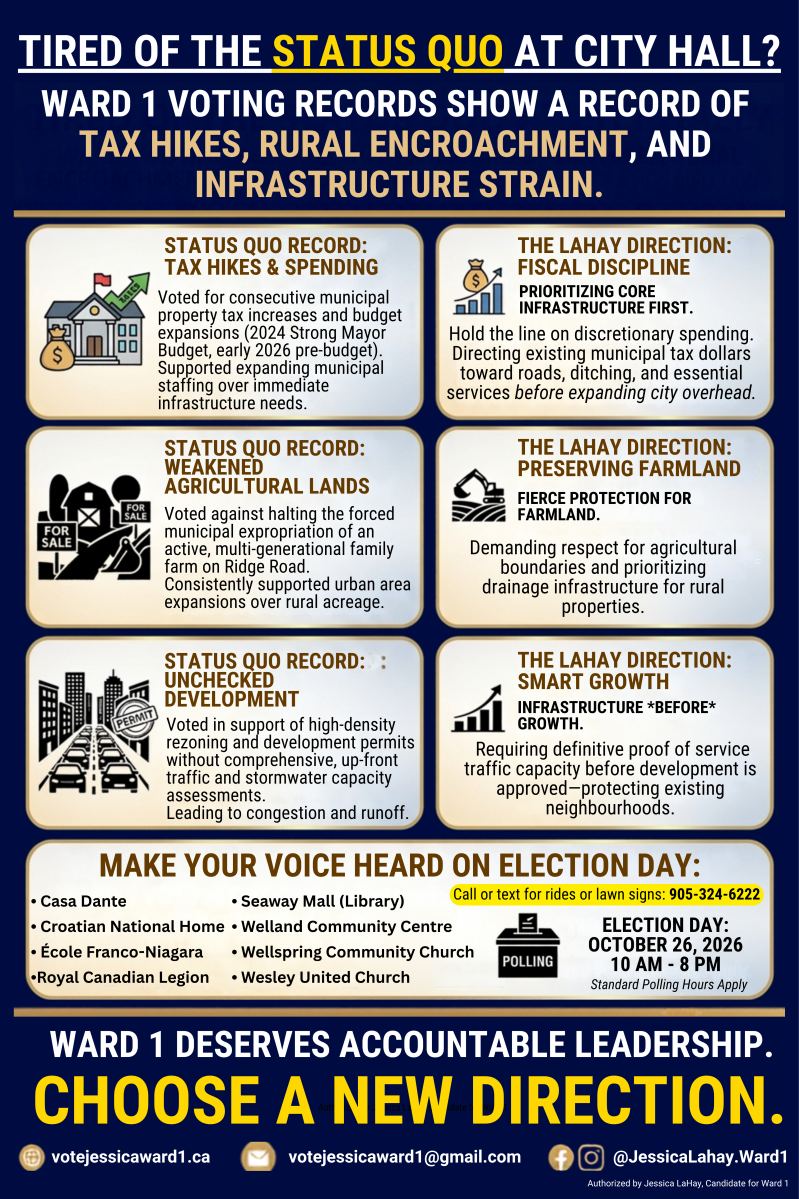
Part 3: A Personal Note: Why I’m Back on the Ballot
Four years ago, when I ran for Ward 1 in 2022, I knocked on doors across Northwest Welland (Ward 1) and heard the exact same frustrations from our neighbors: City Hall wasn’t planning ahead, our roads and stormwater systems were lagging behind, and outside developers were being accommodated while taxpayers carried the freight.
When the polls closed in 2022, my dedication to our community didn’t stop. Following that election, after wrapping up my term serving on the Welland Heritage Advisory Committee when city staff appointed a new volunteer board, I stayed closely engaged. I didn’t just vanish until the next election cycle rolled around. Over the past four years, I’ve been listening in the background, tuning into council livestreams, reading the meeting minutes, —digging into the numbers and decisions to understand why City Hall keeps making choices that leave everyday residents behind. Alongside leading the Welland Rose Festival and operating my business locally I’ve kept my eyes on how decisions are being made.
Watching this recent mayoral debate, it became frustratingly clear that the warning signs so many of us sounded in 2022 were simply brushed aside. The internal squabbling grew worse, more than half of our municipal facilities have fallen into disrepair, and our infrastructure deficit has only deepened.
Like you, I’m tired of the bickering. We need to get back to serving residents, not egos. I’m running again in 2026 because Ward 1 cannot afford another four years of passive representation. I have the persistence, the homework done, and the independence to make sure our neighborhoods have an active, watchful voice standing up for them at City Hall.
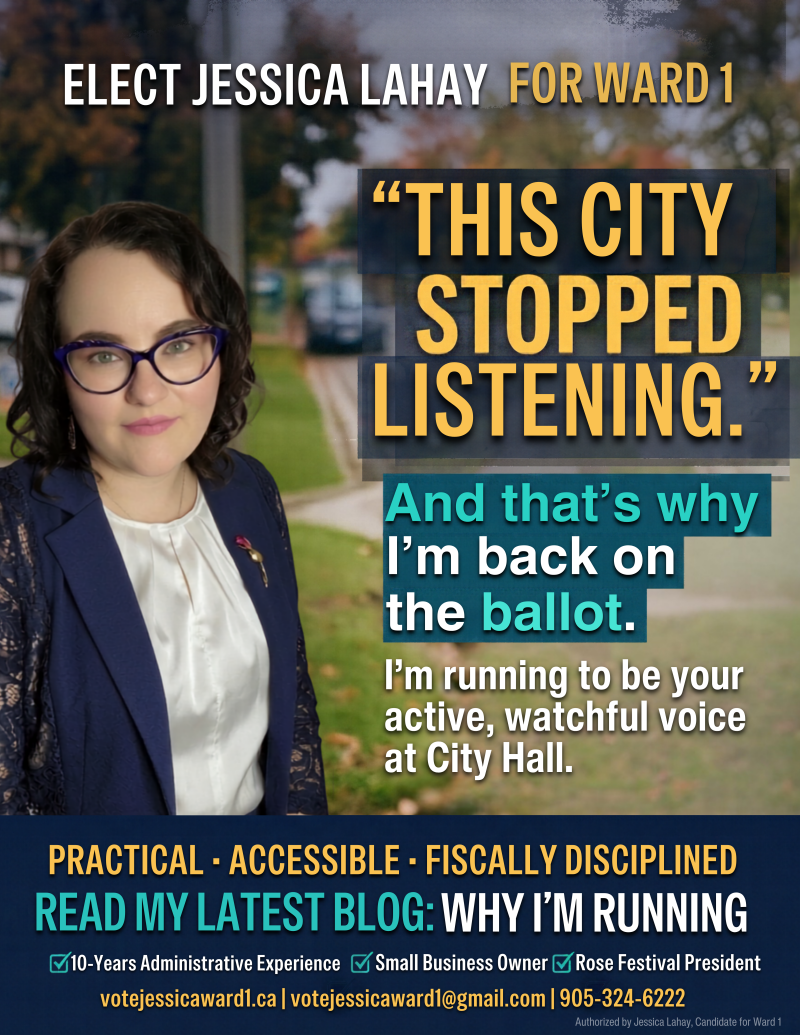
A Personal Note: Why I’m Back on the Ballot—Because This City Stopped Listening
Four years ago, when I ran for Welland City Council in Ward 1, I spent my days and evenings doing the most important work any candidate can do: I knocked on doors, stood on your porches, and listened.
Back then, from Northwest Welland to the boundaries of Ward 1, I heard the exact same frustrations from our neighbors. People told me that City Hall wasn’t planning ahead. They said our roads and stormwater systems were lagging behind. They felt that outside developers were being accommodated while everyday taxpayers were left carrying the heavy freight.
When the polls closed in 2022, my dedication to this community didn't stop. I didn't pack up and vanish until the next election cycle rolled around. I stayed deeply engaged. I wrapped up my term serving on the Welland Heritage Advisory Committee, and over the last four years, I have stayed listening in the background. I have tuned into the council livestreams, read the meeting minutes, and tracked the staff reports. I have dug into the numbers and decisions because I wanted to understand why City Hall keeps making choices that leave everyday residents behind. Alongside leading the Welland Rose Festival through community rebuilding and operating my business right here on the ground, I have kept my eyes on how decisions are being made.
Watching the recent mayoral debate and the ongoing friction at City Hall, it became frustratingly clear: this city stopped listening.
The warning signs so many of us sounded in 2022 were brushed aside. The internal squabbling grew worse. More than half of Welland's municipal facilities have fallen into disrepair, and our infrastructure deficit has only deepened.
Like you, I am tired of the bickering. We need to get back to serving residents, not egos. I am running again in 2026 because Ward 1 cannot afford another four years of passive representation. I have the persistence, the homework done, and the independence to make sure our neighborhoods have an active, watchful, and truly grounded voice standing up for them at City Hall.
What I've Heard on the Trail: The Safety, Infrastructure, and Parks Crisis
Over the past few weeks, knocking on doors across Ward 1, I have heard firsthand what happens when City Hall stops listening—straight from the residents who have to live with the consequences every day.
The Quaker Road Exhaustion
On Quaker Road, residents are beyond exhausted. They are dealing with endless construction delays, torn-up lanes, and persistent backyard drainage issues. One neighbor stood in his driveway and showed me the runoff pooling toward his foundation, asking, "Why is council approving more subdivisions when they can't even get our existing road right?" It is a fair question, and one that City Hall has ignored for too long.
The Danger on Our Corridors: South Pelham, Sumbler, and Foss
Along South Pelham, Sumbler Road, and Foss Road, the lack of foresight has turned into a fundamental safety and accessibility crisis. Residents repeatedly voice alarm over excessive speeding, a total lack of sidewalks, and steep, deep roadside ditches that leave zero safe shoulder space for pedestrians, dog walkers, strollers, or anyone using a mobility scooter.
Turning out from side roads onto South Pelham during peak hours has become a high-risk gamble. Neighbors are practically pleading for traffic lights, traffic calming, and proper sightlines. As one long-time Sumbler Road resident said to me point-blank:
"Cars treat our road like an unchecked speedway bypass to dodge traffic, and with no sidewalks and ditches right at our feet, walking my dog or letting my grandkids ride their bikes has become terrifying. When is City Hall going to care about our safety before someone gets seriously hurt?"
We cannot keep adding traffic to these corridors without designing them for the safety and physical accessibility of everyone who uses them.
Our Forgotten Neighborhood Parks
In our neighborhood parks and green spaces, parents and seniors have shared that our local parks feel abandoned while the city chases shiny new showcase projects elsewhere. From cracked walkways and unshaded benches to aging playground structures, our parks are showing major neglect.
A mom in one of our newer subdivisions summed it up perfectly while watching her kids play in an empty field:
"We love our neighborhood, but our park has zero shade, nowhere for seniors to sit, and nothing for our kids to do once they outgrow a toddler swing set. Why are our tax dollars going to fancy vanity projects when our own neighborhood parks don’t even offer the basics?"
With some of the city's facilities in disrepair, families want City Hall to care for, invest in, and properly maintain the community spaces we use every single day.
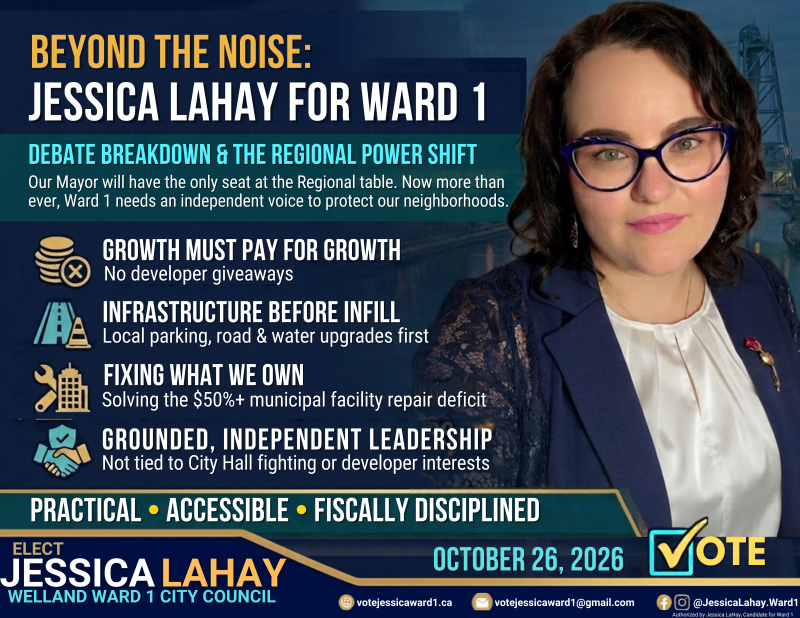
Part 5: Where Jessica LaHay Fits—A Grounded Voice for Ward 1
Here is how my platform takes these doorstep realities and turns them into action on Council:
1. "Growth Paying for Growth" Through a Small Business Lens
The mayoral candidates sparred over a 50% cut to developer fees. As a local small business owner (Visionary Garden Concepts), I look at municipal spending through a practical lens: if you ignore proper grading and drainage when laying out a site, you don’t save money—you just guarantee you’ll be tearing up the entire foundation to fix it later. The city must run on that exact same common-sense discipline.
- Giving development charge breaks without guaranteed, upfront replacement funding forces existing homeowners and seniors on fixed incomes to shoulder higher tax bills.
- My position: Growth must pay for growth. Developers must fully fund the water trunk lines, road widenings, and storm capacity their projects demand before building permits are signed off.
2. Infrastructure Before Infill: Safety, Accessibility, and Fixing High-Congestion Areas
Mayoral candidates repeatedly brought up Quaker Road as a prime example of planning failures.
- We see that same neglect along South Pelham, Sumbler, and Foss. Approving more density without first installing traffic signals at congested intersections, widening shoulders, enclosing hazardous open ditches, or building continuous sidewalks is dangerous and irresponsible.
- I will insist that traffic signals, pedestrian safety measures, and accessibility standards are physically budgeted and scheduled before major growth is approved. Beyond new builds, City Hall must go back into our existing, high-congestion corridors to install the continuous sidewalks, crosswalks, and traffic signals needed to alleviate that traffic burden and finally deliver the safety measures residents have been asking for for years. We must invest in preserving our neighborhood parks, maintaining local green buffers, and protecting the safety and livability of established Ward 1 neighborhoods.
3. Expanding Our Parks: Active Spaces That Offer Something for Everyone
Our neighborhood parks should not just be empty grass fields or afterthoughts in a planning document. We need to expand their everyday usage so they become true multi-generational community hubs that offer something for everyone:
- Covered Gathering Pavilions: Providing sheltered, shaded community spaces for family picnics, neighborhood gatherings, and protection from the summer heat and sudden rain.
- Multi-Use Outdoor Sport Courts & Mini Soccer Fields: Giving local kids and teens dedicated, accessible places to shoot hoops, play pickleball, ball hockey, or kick a soccer ball right in their own neighborhoods without needing a car to cross town.
- Perimeter Walking Tracks: Creating smooth, continuous, accessible paved loops around the park perimeters so seniors, parents with strollers, dog walkers, and fitness enthusiasts can get active safely without dodging traffic or uneven grass.
- Weather-Protected Outdoor Fitness Equipment: Installing heavy-duty, concreted outdoor fitness and exercise stations placed directly under pavilions, ensuring year-round, covered access for functional movement and bodyweight training for all ages and abilities.
4. Practical Leadership That Unifies and Listens
The bickering, personal attacks, and procedural standoffs on that debate stage proved that council needs fewer egos, more cultural unity, and far more constructive discipline. Real leadership is not about trading barbs on camera; it is about bringing people of all backgrounds together, doing the groundwork, and delivering results.
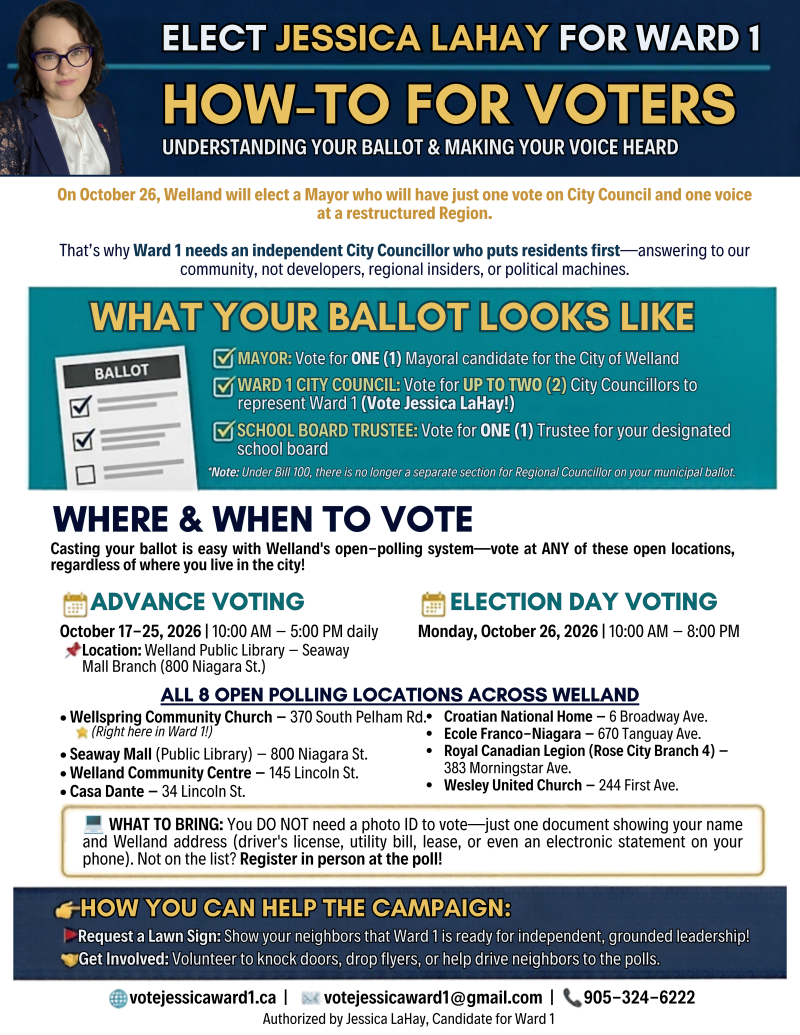
Part 6: How-To for Voters—Understanding Your Ballot & Making Your Voice Heard
Whoever is elected Mayor on October 26th will hold only one vote in Welland's council chamber and will carry our sole voice to a restructured Region.
Ward 1 needs a City Councillor who answers strictly to our residents—not developers, not regional cliques, and not political machines.
What Your Ballot Looks Like
When you step behind the voting screen, remember how your ballot is structured:
- Mayor: You vote for one (1) Mayoral candidate for the City of Welland.
- Ward 1 City Council: You vote for up to two (2) City Councillors to represent Ward 1.
- School Board Trustee: You vote for one (1) Trustee for your designated school board.
(With the province’s regional governance changes under Bill 100, there is no longer a separate section for Regional Councillor on your municipal ballot).
Where and When to Vote
Casting your ballot is easy thanks to Welland's open-polling system—you can vote at any open polling location across the city, regardless of which ward you live in!
Advance Voting:
- Dates & Hours: October 17–25, 2026 | 10:00 AM – 5:00 PM daily
- Location: Welland Public Library – Seaway Mall Branch (800 Niagara St.)
Election Day Voting:
- Date & Hours: Monday, October 26, 2026 | 10:00 AM – 8:00 PM
- All 8 Open Polling Locations Across Welland:
- Wellspring Community Church – 370 South Pelham Rd. (Right here in Ward 1!)
- Seaway Mall (Welland Public Library) – 800 Niagara St.
- Welland Community Centre – 145 Lincoln St.
- Casa Dante – 34 Lincoln St.
- Croatian National Home – 6 Broadway Ave.
- École Franco-Niagara – 670 Tanguay Ave.
- Royal Canadian Legion (Rose City Branch 4) – 383 Morningstar Ave.
- Wesley United Church – 244 First Ave.
Note: You do not need a photo ID to vote—just one document showing your name and Welland address (driver’s license, utility bill, lease agreement, or even an electronic bank or utility statement on your smartphone). If you are not on the voter list yet, election staff can register you in person right at the polling station.
How You Can Help Support the Campaign:
- Request a Lawn Sign: Show your neighbors that Ward 1 is ready for independent, grounded leadership. Email, call, or visit the website to request a sign delivered directly to your lawn.
- Get Involved: Volunteer to knock doors, drop flyers, or help drive neighbors to the polls.
A Heartfelt Thank You to Ward 1
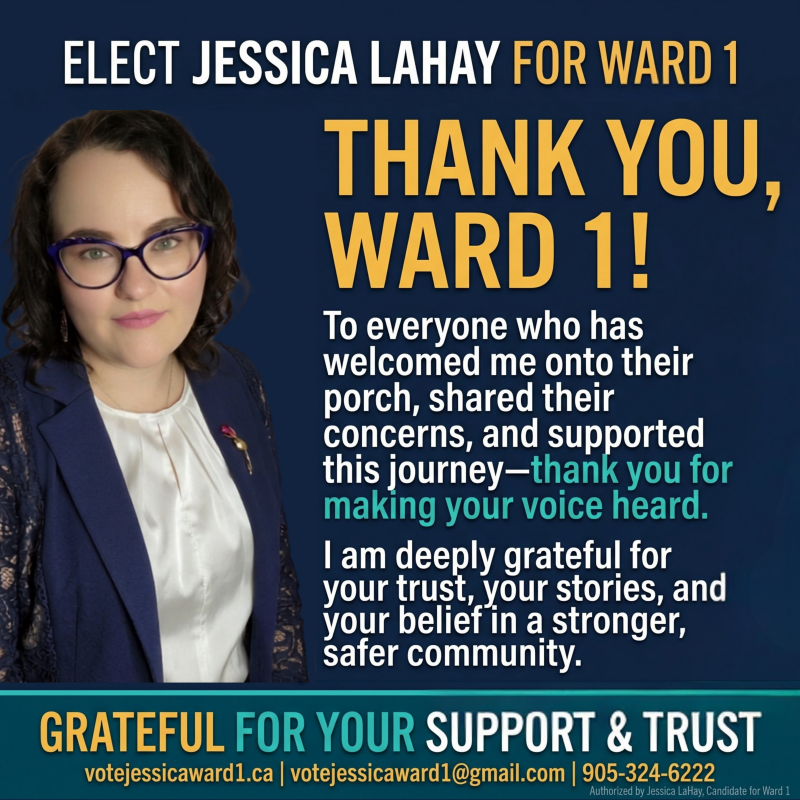
To every resident who has welcomed me onto their porch, shared their concerns in their driveway, or taken the time to talk on the street—thank you.
Campaigning across Ward 1 is a reminder of how deeply our neighbors care about this city and about each other. Your stories, your frustrations, and your hopes for our community are what drive this campaign every single day. Win or lose, earning your trust and listening to your voices is the greatest privilege of this journey.
Thank you for your ongoing support, your encouragement, and for believing that together, we can bring common sense, transparency, and authentic community leadership back to City Hall. I look forward to continuing these conversations at your door and working hard to earn one of your two votes on October 26th!
Connect with Jessica LaHay:
-
Website: votejessicaward1.ca
-
Email: votejessicaward1@gmail.com
-
Phone: 905-324-6222
Add comment
Comments