

This week, as your candidate running for Welland City Council in Ward 1, I attended Niagara Elections 2026: Changes and Challenges, hosted by the Niagara Community Observatory (NCO) at Brock University inside Pond Inlet.
Moderated by NCO Director Dr. Kyle Rich, the forum brought together researchers, policy specialists, and candidates from across our region. The evening opened with an invocation of the Two-Row Wampum and the dish-with-one-spoon teachings—a reminder of mutual respect, cooperation, peaceful coexistence, and shared stewardship of the land and community life.
For Welland, these principles are essential. Decisions made across Niagara directly shape what happens along our streets, in our local parks, across our industrial lands, and in our municipal budget. The discussions spanned four core pillars: Regional Governance and Democratic Accountability, Municipal Economic Development, Affordable and Supportive Housing, and Parks and Recreation.
1. Regional Governance and Democratic Accountability: What It Means for Welland
The opening discussion featured Dr. David Siegel, Professor Emeritus of Political Science and founder of the NCO. Dr. Siegel framed local government as balancing between two opposite poles: a genuine democratic institution where elected representatives make local choices, versus a decentralized administrative arm acting merely as a delivery agent for Queen’s Park.
Significant structural changes are transforming regional governance, with direct impacts on Welland taxpayers:
-
Provincially Appointed Regional Chair: Rather than regional councillors selecting their chair, the position will now be provincially appointed under the province's restructured governance framework. Dr. Siegel highlighted the unusual dynamic of having 12 elected mayors seated around a regional council table chaired by a provincial appointee endowed with expanded executive powers.
-
Mayors as Sole Regional Representatives: Welland has historically elected two Regional Councillors alongside our Mayor to represent our city at the regional level. Under the new structure, those independently elected regional seats are eliminated. Welland will have exactly one seat and one vote at Regional Council: our Mayor. Dr. Siegel raised concerns regarding divided loyalties when municipal interests clash with broader regional priorities, as well as constituent workload. For larger cities like St. Catharines, one mayor will represent 154,000 residents on all regional matters, creating severe accessibility bottlenecks.
-
Weighted Voting: Moving from a 32-member council to a 12-mayor table introduces weighted voting formulas, creating difficult balances between large urban centers like St. Catharines or Niagara Falls and rural municipalities like Wainfleet. Welland must ensure its voice is never diminished during regional budget debates.
Questions Raised to Dr. David Siegel
-
Candidate Performance and Qualifications: A municipal candidate asked how voters can look past "popularity contests" and evaluate whether candidates have the skill to handle multi-million-dollar infrastructure deficits, citing St. Catharines' $100-million water and wastewater backlog.
-
Dr. Siegel's Response: Siegel emphasized that voters must probe platforms rather than personalities. When candidates promise to control taxes, residents need to ask specifically how they will achieve it. Local government impacts daily life more directly than any other tier, and voter turnout must be driven by informed understanding rather than superficial slogans.
-
-
Unification into a Single "City of Niagara": A participant from Lincoln asked whether 12 local municipalities remain sustainable and if amalgamation is the inevitable solution.
-
Dr. Siegel's Response: Siegel noted that municipal amalgamations across Ontario have rarely produced significant long-term cost savings. People maintain deep personal attachments to their local municipalities, and forced amalgamations elsewhere have caused decades of lingering conflict over facility closures, service cuts, and lost local identity. For Welland, preserving our unique municipal identity and neighborhood representation remains vital.
-
-
Regional Action on Homelessness & Mental Health: Bea Kenny, mayoral candidate for Port Colborne, asked how the new 12-mayor table will address regional homelessness and mental health crises.
-
Dr. Siegel's Response: While expressing confidence in the mayors, Siegel stressed that managing municipal administration while coordinating regional social service systems simultaneously will place an immense workload on mayors.
-
-
Escarpment Irrigation & Citizen Oversight: Paul Enns, mayoral candidate for Pelham, raised the idea of an informal "shadow cabinet" of former representatives and asked if the NCO would study expanding irrigation infrastructure into Pelham's clay belt above the escarpment for greenhouse agriculture.
-
Dr. Siegel's Response: Siegel acknowledged longstanding North-South regional divisions, while Dr. Kyle Rich offered to connect relevant research resources regarding agricultural irrigation after the session.
-
-
Impacts on Ward Councillors: Former regional councillor Bruce Timms asked if local city councillors will be forced to absorb regional constituent issues now that directly elected regional councillors no longer exist.
-
Dr. Siegel's Response: Siegel agreed that when residents cannot access their mayor, they will naturally bring their regional complaints directly to ward councillors, significantly expanding the informal responsibilities of local representatives.
-
2. Municipal Economic Development: Shifting the Focus to Welland Workers
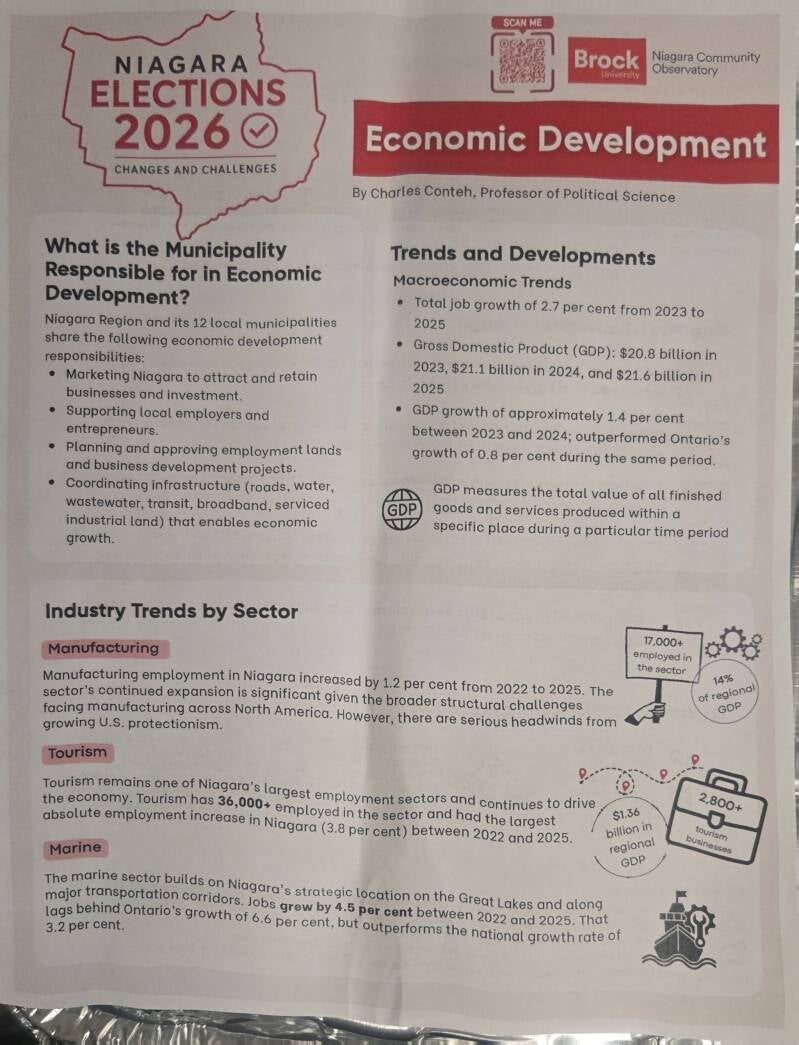
Dr. Charles Conteh, Professor of Political Science and former NCO Director, led the discussion on regional economic policy. Dr. Conteh differentiated between the narrow view of economic development (marketing, business attraction, and retention) and its broader reality: supplying the serviced employment lands, transportation grids, water/wastewater networks, and energy grids required for enterprises to operate.
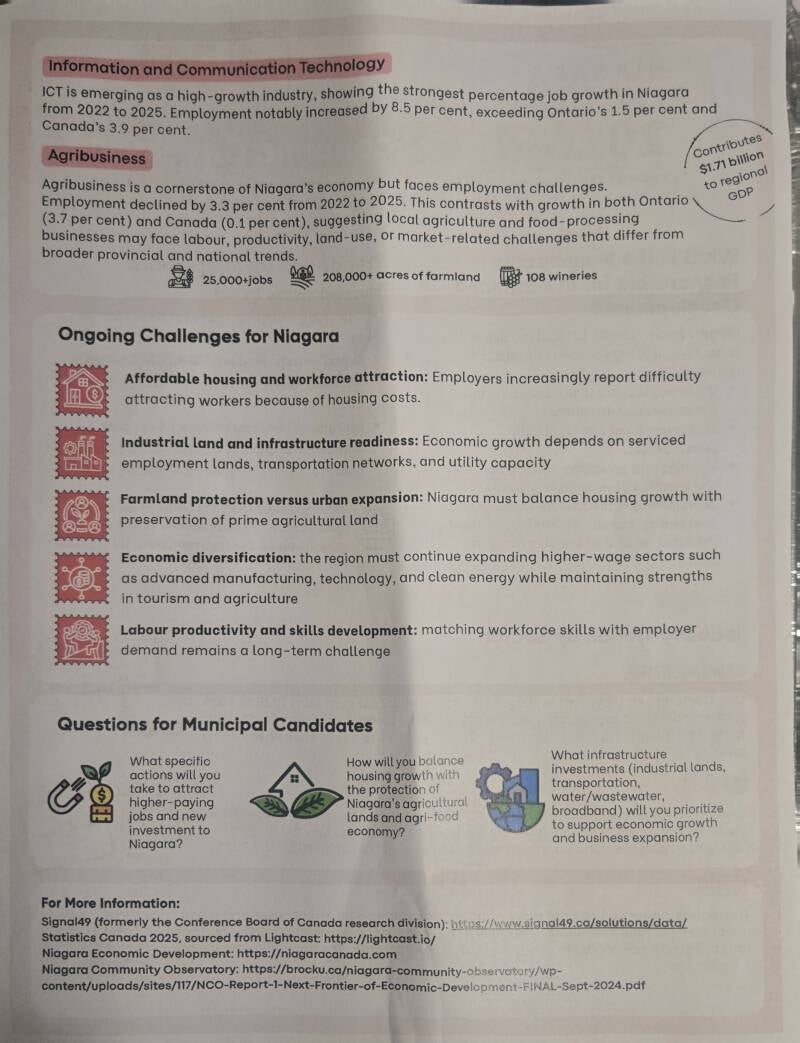
Dr. Conteh noted that Niagara has spent two decades transitioning from the heavy industrial dislocations of the 1980s and 1990s toward small- and medium-sized enterprises (SMEs). While regional GDP grew by 1.4% (outperforming Ontario's 0.8%) and job numbers grew by 2.3%, he warned that job quality remains an urgent issue, with an overreliance on low-wage and seasonal employment. Core regional challenges include serviced industrial lands, protecting prime farmland against urban sprawl, and attracting higher-wage sectors such as advanced manufacturing, clean technology, and agribusiness.
Questions Raised to Dr. Charles Conteh
-
Retaining Post-Secondary Talent: Noel Buckley, council candidate for Ward 2 in St. Catharines, argued that economic development too often pursues outside corporate footprints rather than retaining graduates from Brock University and Niagara College, noting that 8 of Niagara's top 10 employers are public institutions.
-
Dr. Conteh's Response: Conteh agreed, citing an NCO study recommending coordinated talent retention strategies across municipalities and post-secondary schools. Municipalities must build direct relationships through co-ops and paid placements before students graduate, creating roots and local attachment. For Welland, home to Niagara College's Welland Campus, building these direct links is an immediate economic imperative.
-
-
Niagara District Airport Potential: An attendee asked why municipalities have not leveraged the Niagara District Airport runway to connect Niagara with larger North American commercial and trade hubs.
-
Dr. Conteh's Response: Conteh noted that while the logistical business case exists, the issue lacks consensus due to community concerns regarding noise pollution, urban boundaries, and surrounding airport competition in Hamilton, Toronto, and Buffalo.
-
-
Streamlining Regulations for Small Business: A mayoral candidate pointed to municipal permitting delays and red tape that hinder small businesses and restaurants.
-
Dr. Conteh's Response: Conteh cited Rochester, New York, where municipal leaders performed a policy inventory to streamline regulations following industrial decline. He supported periodic policy reviews in Niagara to eliminate unnecessary administrative roadblocks while preserving environmental and consumer protections.
-
-
Minimum Wage vs. Regional Living Wage: An attendee asked why minimum wage does not adjust locally to match regional living costs.
-
Dr. Conteh & Dr. Joanne Heritz's Response: Conteh clarified that minimum wage is provincial jurisdiction. Dr. Heritz added that regional advocacy focuses on a living wage, noting Niagara’s living wage is estimated at roughly $22 per hour, well above provincial minimum standards.
-
-
Regional Transit Advocacy: An attendee raised the barrier of commuting in and out of Niagara without relying entirely on highway traffic.
-
Dr. Conteh's Response: Conteh emphasized multi-level governance, explaining that municipalities must coordinate regional data to build strong cases with Metrolinx and provincial ministries for expanded GO train and inter-municipal transit service. For Welland commuters, reliable regional connectivity is a necessity for accessing employment across the peninsula.
-
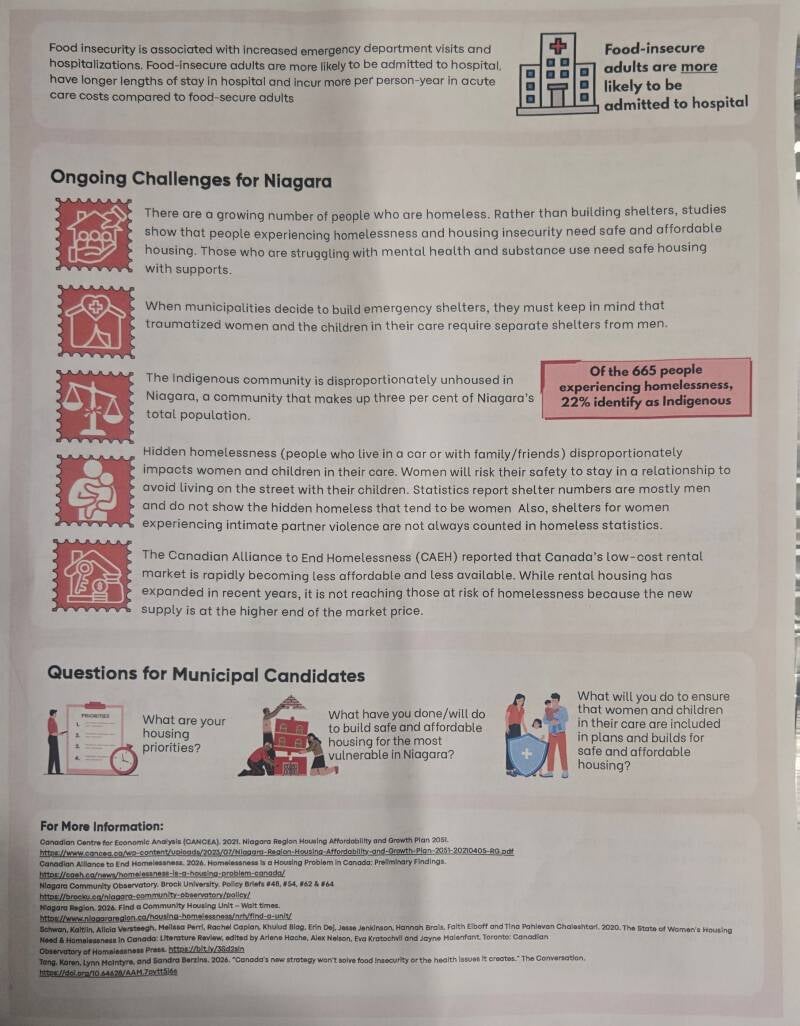
3. Affordable and Supportive Housing: Welland's Core Challenge
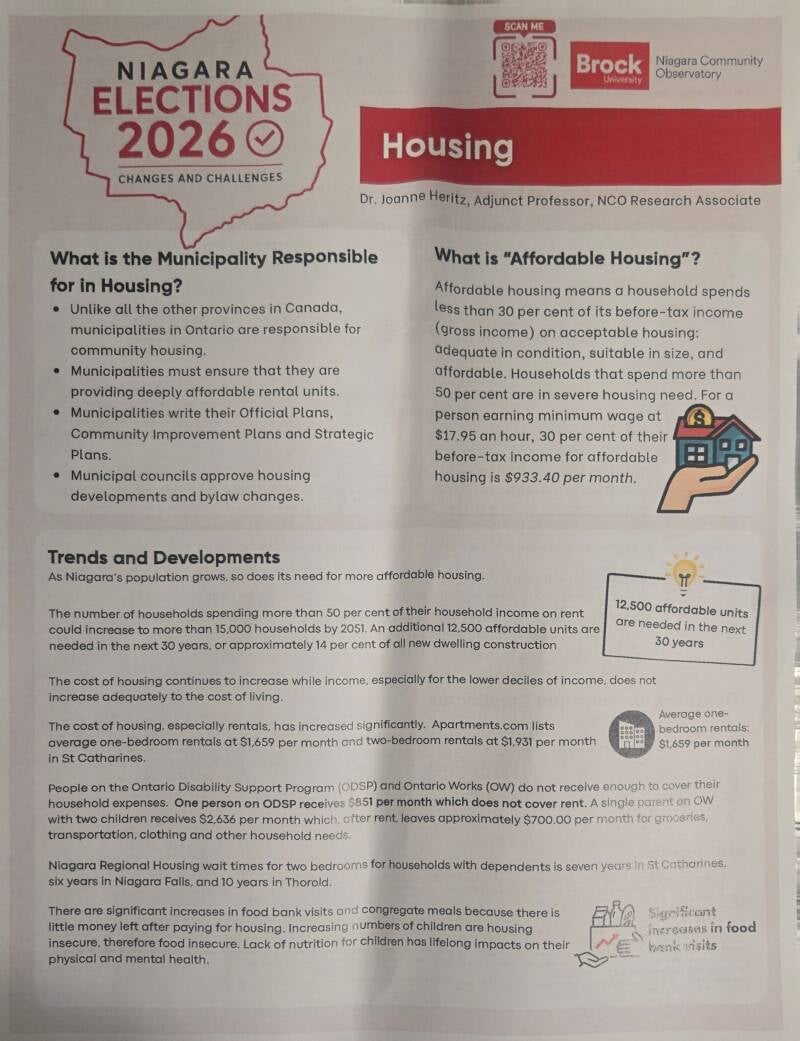
Dr. Joanne Heritz, Adjunct Professor of Political Science and NCO Research Associate, presented on Niagara’s housing reality. In Ontario, community housing is a municipal responsibility managed through official plans, Community Improvement Plans (CIPs), and zoning approvals.
Dr. Heritz outlined critical regional data that hits home in Welland:
-
The Scale of Need: Over 76,000 individuals across Ontario are experiencing homelessness, projected to reach 89,000 by 2028. Niagara has an immediate deficit of 945 supportive housing units. Across the region, 12,500 affordable units are needed over the next 30 years.
-
Disproportionate Impacts & Hidden Homelessness: Indigenous people represent 22% of Niagara's unhoused population while making up 3% of the total regional population. Dr. Heritz highlighted hidden homelessness among women and children, noting women often remain in unsafe environments to avoid shelter systems and frequently go uncounted on official waitlists.
-
The Affordability Gap in Working Communities: Housing affordability requires spending under 30% of gross income on shelter. A full-time minimum-wage earner ($17.95/hr) can afford up to $933 monthly. However, the average one-bedroom rental in St. Catharines sits around $1,600 to $1,659 per month, a reality mirrored across Welland's rental market where working families are increasingly priced out.
-
Wait Times & Social Assistance Deficits: Wait times for a two-bedroom unit with dependants through Niagara Regional Housing span 78 to 80 months (over 6.5 years). A single parent with two children on Ontario Works receives about $2,636 monthly, leaving only about $700 for food, transportation, and clothing after rent—directly driving surging use at Welland food banks and community meal programs.
Questions Raised to Dr. Joanne Heritz
-
Funding Sources for Affordable Builds: Audience members asked what capital funding sources exist beyond property tax levies.
-
Dr. Heritz's Response: Heritz noted CMHC programs, provincial housing grants, and the federal Build Canada Homes program. However, federal programs frequently require complex matching funding from municipal, provincial, and private partners. She urged municipalities to require developers to include affordable rental units in private builds and lamented the decline of non-profit cooperative housing models from the 1980s.
-
-
Short-Term vs. Long-Term Policy: Terry Thompson, council candidate in Niagara Falls, asked for practical plans municipalities can enact without overburdening taxpayers.
-
Dr. Heritz's Response: Short-term policies must require developers to include affordable units in new rental developments and townhouse complexes. In the long term, cities must diversify away from exclusively single-family subdivisions to build attainable, purpose-built rentals matching local income levels. In Welland, updating our zoning to support gentle density, secondary suites, and purpose-built rentals is essential to keeping young people and seniors in the community.
-
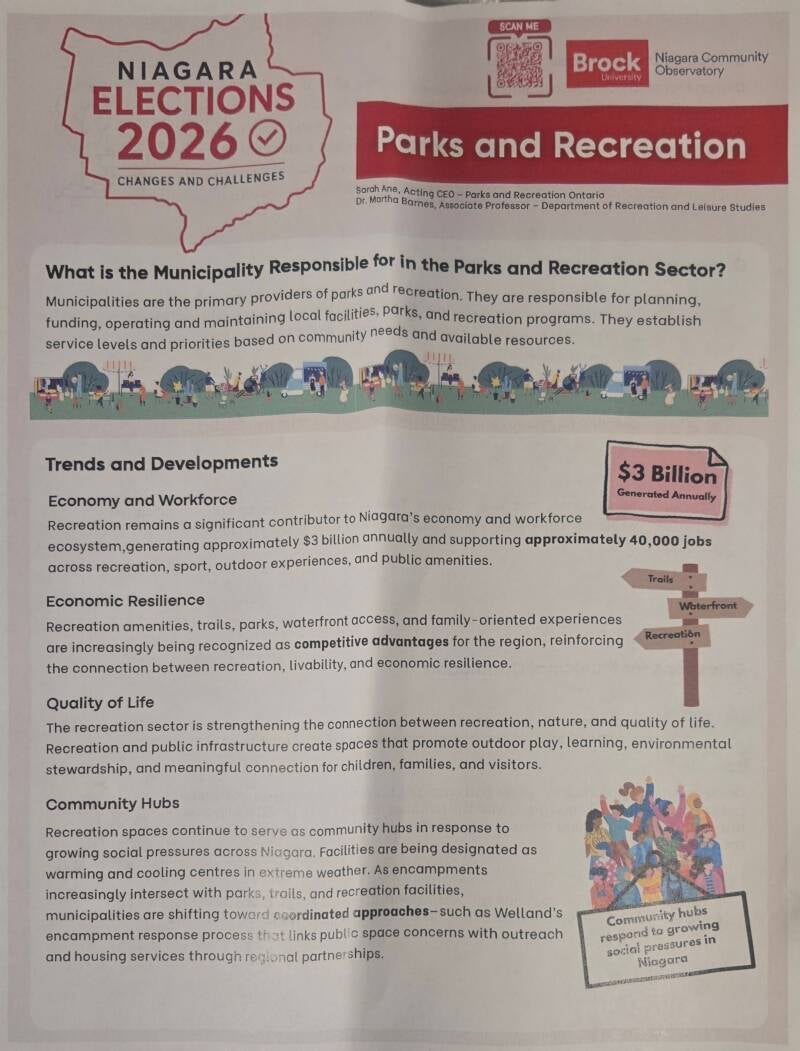
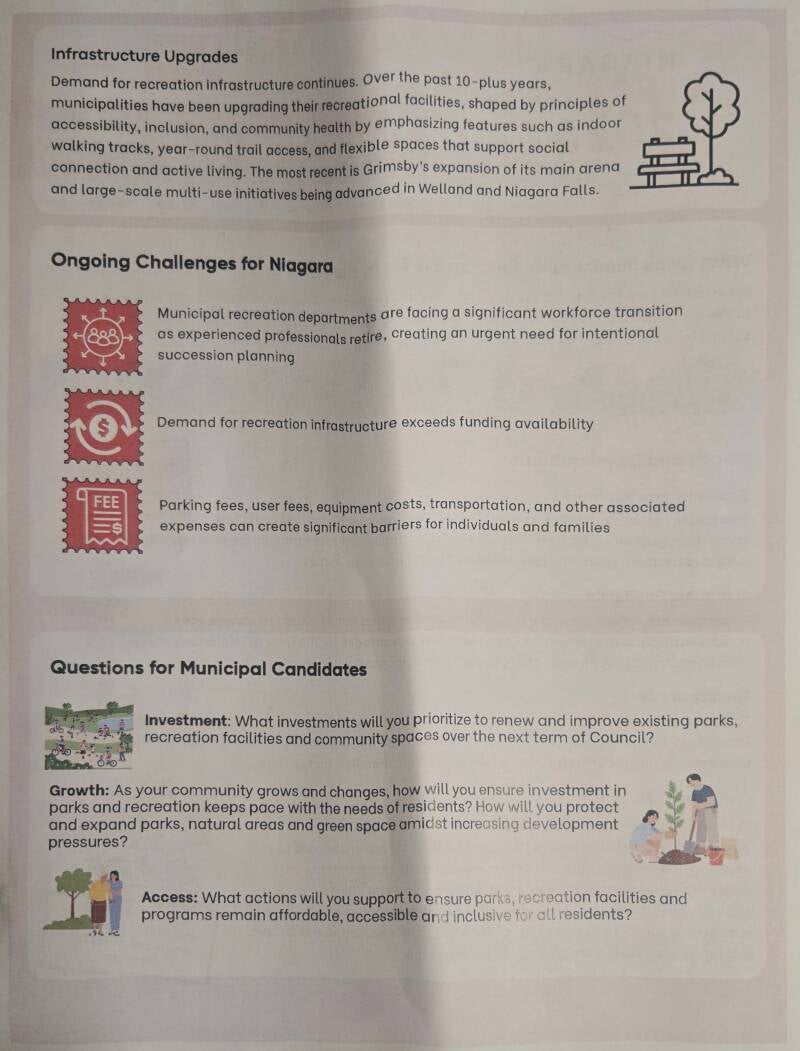
4. Parks, Recreation, and Community Resilience: Investing in Welland Neighborhoods
Dr. Martha Barnes (Associate Professor of Recreation and Leisure Studies, Brock University) and Sarah Ane (Acting CEO of Parks and Recreation Ontario) detailed why municipal recreation is critical public infrastructure. Municipalities are the primary delivery agents for recreation, managing parks, trails, community centers, pools, arenas, and local cultural spaces.
Key insights included:
-
Community Resilience Hubs: Facilities serve as frontline disaster response centres. They act as cooling and warming centres, evacuation shelters, and emergency clinics. Dr. Barnes noted that during an industrial fire and neighbourhood evacuation in northern St. Catharines, displaced families found refuge at the Kiwanis Centre. The panel also highlighted Welland’s own encampment response process, which coordinates outreach and housing services across public spaces and recreation facilities.
-
The Infrastructure Deficit: Ontario faces a $9.5 billion recreation and sport infrastructure backlog, second only to roads in total municipal asset deficits.
-
Social Pressures on Recreation Staff: Frontline park and community centre staff increasingly encounter homelessness, addiction, and mental health crises, underscoring an urgent sector-wide training need for de-escalation and social support.
-
Economic Value: Recreation supports tens of thousands of regional jobs and plays an active role in economic attraction. Dr. Barnes highlighted Niagara Health’s doctor recruitment campaigns, which heavily featured local parks, beaches, the Niagara Gorge, and trail networks to attract medical specialists.
Questions Raised to Dr. Martha Barnes & Sarah Ane
-
Recreation as an Essential Service: An attendee asked what elected officials must do to protect recreational infrastructure from chronic underfunding.
-
Dr. Barnes' Response: Councils must formally validate parks and recreation as an essential municipal service rather than discretionary spending to cut during budget cycles. She urged candidates to ensure housing developments integrate complete communities with preserved green space rather than afterthought pocket parks.
-
-
Equitable Neighborhood Investment in Welland: In post-panel discussions, attendees specifically raised neighborhood-level access to parks and recreation in Welland. Conversations highlighted community-led ideas like an illuminated winter pathway and ice skating in Woodlawn Park, alongside concerns over uneven municipal investment between facilities—such as ongoing investments into primary facilities while neighborhood amenities like the pool at Maple Park go decades without significant renewal. As Welland expands with new families, public recreation investments must reach every ward equitably, rather than concentrating solely on marquee sites.
The New Reality of Welland Governance: Teamwork on Council and Mayoral Accountability
The restructuring of Niagara Regional Council alters how Welland must be governed.
With the elimination of independently elected Regional Councillors, Welland will have exactly one seat and one vote at Regional Council: our Mayor.
This change creates a structural shift that demands a collaborative and accountable approach from our local leadership:
1. Teamwork and Collaboration Within Welland City Council
Welland City Council consists of 12 ward councillors (two representing each of our six wards) working alongside the Mayor. With the elimination of regional councillors, ward councillors will no longer be solely municipal administrators—we will become the primary democratic frontline for every resident concern in our neighborhoods.
When a resident has an issue with regional services—whether it is regional transit routes, social housing waitlists, public health programs, regional arterial roads, or wastewater billing—they will no longer have regional representatives to call. They will turn to their ward councillors.
City Council cannot function as six disconnected silos or descend into factional infighting. Delivering for Ward 1 requires genuine teamwork across all wards. We need a collaborative council table that shares neighborhood intelligence, builds consensus on infrastructure renewal (such as updating long-neglected amenities like Memorial Pool and Maple Park), and presents a united front when establishing capital spending priorities.
2. Demanding Mayoral Accountability at the Regional Table
Because Welland’s Mayor is now our single voice at Regional Council, the local council table must serve as the primary check and balance on regional governance.
We cannot have a situation where our Mayor travels to regional headquarters in Thorold, makes decisions behind closed doors, or votes on multi-million-dollar regional budgets and water/wastewater rates without direct input from, and reporting back to, Welland City Council.
As your Ward 1 Councillor, I will ensure City Council institutes regular regional accountability mechanisms:
-
Mandatory Regional Reporting: A formal standing item on Welland City Council agendas where the Mayor must present regional council proceedings, committee updates (such as Police Services, Housing, and Conservation authorities), and upcoming regional votes.
-
Binding Council Direction on Major Regional Issues: Before key regional votes—such as regional tax levy hikes, changes to transit routes, or industrial land conversions—the Mayor should receive debate, scrutiny, and clear policy guidance from the elected ward councillors who represent Welland’s residents.
-
Defending Welland’s Fair Share: In a regional system featuring weighted voting and strong-chair appointments, our lone mayoral representative must be held accountable to fight tenaciously for Welland’s share of regional transit investments, housing units, and infrastructure dollars, rather than acquiescing to provincial or larger-city agendas.
Holding Economic Development Accountable: My Exchange with Dr. Charles Conteh
When the floor opened for questions on municipal economic development, I wanted to address a core challenge we face in Welland: ensuring that corporate subsidies and public planning approvals deliver real, permanent benefits to the people who live in our community.
Here is the exact transcript of my question and Dr. Conteh's response:
Jessica LaHay (1:19:29):
"My name is Jessica. I am a Candidate running for Council in Welland for Ward 1. And my question goes to Charles Conteh. In speaking about the total growth of 2.7% from 2023 to 2025, the broader macroeconomic indicators suggest steady job growth, but our community's day-to-day reality tells a different story. Too often we see major incentives, zoning, and municipal tax relief offered to attract large manufacturing facilities, only for those investments to deliver minimal return to the people who actually live here. And in some cases, operators hire largely from outside our boundaries, while other facilities scale back or abandon our industrial lands entirely after that incentive expires.
So rather than subsidizing footprints without accountability, our city needs enforceable safeguards. So my question to you is, what specific mechanisms, such as Community Benefits Agreements or CBAs or mandatory subsidy clawback clauses, can the city integrate into our economic development policy to ensure that public subsidies and approvals are tied to verifiable local hiring quotas and retention commitments?"
Dr. Charles Conteh (1:20:51):
"Sorry, you know, you can talk about the economic data, and I want to share with you essentially a lot of what's meant to be done to the globe. But the question I'm asking is, how does that translate into economic, social, and ecological well-being? And that's the question, that's the central policy question. Economic development, economic growth, GDP growth as a result, and what the end game ultimately—how it translates into a thriving community and a just society essentially is the end game.
And fundamentally, I think, you know, some municipalities, for instance, just down higher in Niagara, in Hamilton, they have a 4 bottom line. So they don't separate economic and social from the environmental and ultimately from the cultural. Right? Now, the one good news in Niagara is that beyond that GDP growth of 1.4% over the past 3, 4 years, you also have job growth of 2.3%. So in fact, there is that new investment that is being translated into new jobs.
But then I would push forward and say, what kinds of jobs? Unfortunately, the quality of jobs are not there. So what we tend to have is low-paying jobs, seasonal jobs... So yes, there's still work to do beyond the economic data, beyond GDP growth, beyond the sectoral gains in agribusiness or manufacturing or the tech sector or tourism. How will those growth numbers translate into not just jobs—yes, job growth—but quality jobs? One of the questions I asked was, how will you attract investment that would lead to high-quality employment? And that is the challenge in my area.
There is this gulf between the growth trajectory economically and how it translates into social, ecological, livelihood, environmental, and human development. And that is the most important question we should ask. And I'm glad that you as a politician are really invested in that, because [the work] is to connect these two worlds. The economic and the social are inextricably intertwined. I can speak to the economic model, and then you can ask: how will it translate? And that's the policy question, and that's what I'll try to capture in the talk. How will the economy translate into human well-being, human thriving, and social development? That's the next stage."
The Welland First Proposal: Securing Jobs for Local Residents
Dr. Conteh correctly identified that headline economic growth numbers mean little if they do not lead to long-term community thriving and secure employment for local residents. When the City of Welland opens up serviced industrial employment lands, grants municipal property tax relief, or offers planning exemptions, the return on investment must directly benefit the people living within our municipal borders.
To secure jobs for our local workforce, I am proposing a "Welland First" Community Benefits and Economic Accountability Policy built on three actionable mechanisms:
-
Mandatory Community Benefits Agreements (CBAs) on Subsidized Builds:
Any major industrial or commercial development receiving municipal tax relief (such as Tax Increment Equivalent Financing / TIEF), grants through Community Improvement Plans (CIPs), or subsidized city-owned employment lands must sign a legally binding CBA. This agreement will require that a verified percentage (such as 30% to 40%) of operational and construction workforce hours be reserved for local residents from Welland and the Niagara Region.
-
Verifiable Subsidy Clawback Clauses:
Municipal financial relief must never be unconditional. If a corporation accepts taxpayer incentives based on commitments to create full-time jobs, but later shifts hiring outside the local municipality, lowers promised wage standards, or downsizes and vacates the property after incentives expire, the City of Welland must hold contractual authority to claw back municipal funds.
-
Direct Post-Secondary and Trades Pipelines:
Incentivized employers must maintain formal partnerships with Niagara College, local trade unions, and employment agencies to establish direct apprenticeship pipelines, ensuring local students and workers step directly into skilled employment.
Proof It Works: Community Benefits Precedents Across Ontario
Community Benefits Frameworks (CBFs) and agreements are established municipal best practices across Ontario:
-
City of Toronto — Community Benefits Framework & Rexdale CBA:
Toronto formally adopted a city-wide Community Benefits Framework for municipal procurement, leasing, and development approvals. Under the Rexdale–Casino Woodbine Community Benefits Agreement, the city made planning approvals conditional on a legally binding requirement that 40% of all new operational hires be local residents and members of equity-deserving groups, enforced by third-party tracking and annual reporting to City Council. Furthermore, under Toronto’s IMIT / EDGE programs, businesses receiving municipal property tax increment grants must submit a binding Community Workforce Development plan connecting tax relief to local hiring.
-
Windsor–Detroit Bridge Authority — Gordie Howe International Bridge:
The Canadian procurement contract embedded a formal Workforce Development and Participation Strategy requiring that at least $250 million in design-build project value be executed by contractors and suppliers within Windsor-Essex and within 100 kilometres of the site, while mandating that at least 20% of new hires be recruited locally.
-
Metrolinx — Major Transit Projects (Eglinton Crosstown, Finch West, Hurontario LRT):
Metrolinx established a Community Benefits and Supports Program across major corridor builds, contractually requiring project consortia to allocate a minimum percentage (historically 10%) of trade apprentice working hours to local and historically disadvantaged residents, supported by partnerships with local labour networks. Over $35.7 million in verified social procurement has been directed to local businesses and social enterprises.
-
City of Ottawa & ACORN — Herongate Community Benefits Agreement:
During major multi-phase rental redevelopments in Ottawa, planning and rezoning approvals were leveraged to negotiate binding commitments from private developers for local construction apprenticeships, dedicated affordable housing units, and neighbourhood amenity investments.
-
City of Hamilton — Quadruple Bottom Line (QBL) & LRT Advocacy:
As Dr. Conteh referenced, Hamilton utilizes multi-bottom-line metrics to weigh capital projects not just on financial returns, but on environmental, social, and cultural well-being. Community coalitions like the Hamilton Community Benefits Network (HCBN) work directly with the city and Metrolinx to tie the $3.4-billion LRT project to local hiring and apprentice targets.
These examples confirm that conditioning municipal approvals and incentives on local job guarantees is standard practice in Ontario municipal governance.
Action at City Hall: Proposed Notice of Motion for Welland City Council
When elected to Council, I will introduce this formal motion to establish an accountability framework for City of Welland taxpayers and workers:
NOTICE OF MOTION: ESTABLISHMENT OF A WELLAND COMMUNITY BENEFITS AND ECONOMIC ACCOUNTABILITY FRAMEWORK
MOVED BY: Jessica LaHay
SECONDED BY: [Councillor Name]
WHEREAS the City of Welland regularly utilizes municipal incentives, including Community Improvement Plan (CIP) grants, Tax Increment Equivalent Financing (TIEF), planning and zoning relief, and publicly serviced employment lands to attract commercial and industrial investment;
AND WHEREAS public tax dollars, municipal infrastructure investments, and municipal lands must deliver verifiable economic, social, and employment benefits to residents living within the City of Welland;
AND WHEREAS municipalities and transit authorities across Ontario have successfully implemented Community Benefits Frameworks and local hiring requirements to secure measurable returns on public investment;
THEREFORE BE IT RESOLVED:
1. THAT Welland City Council direct City Staff (Economic Development, Planning, and Legal Services) to report back to Council within six (6) months with a draft "Welland Community Benefits and Economic Accountability Policy";
2. THAT this policy establish mandatory requirements for any development or employer receiving municipal financial incentives, CIP tax relief, or subsidized municipal land transactions exceeding $250,000 in value, including:
a) Mandatory Community Benefits Agreements (CBAs) setting verifiable targets for local hiring, apprenticeships, and local supply-chain procurement;
b) Binding "Subsidy Clawback Clauses" requiring the reimbursement of municipal incentives if an employer fails to meet verified job-creation, local retention, or continuous operation commitments; and
c) Direct coordination with Niagara College, local trade union halls, and regional employment services to establish dedicated training and hiring pipelines for Welland residents;
3. THAT the policy establish mandatory annual reporting to City Council detailing employer compliance, verified local hiring figures, and job quality metrics.
Connecting regional economic policy with local social well-being is the core priority of my campaign for Ward 1. Welland residents deserve leadership ready to collaborate within City Council, hold our regional representation accountable, champion community spaces, protect accessible housing, and secure enforceable returns on every public dollar.
Sources & Reference Checklist
1. Forum Event & Academic Research (Brock University / NCO)
- Event Organizer & Host: Niagara Community Observatory (NCO) at Brock University (Niagara Elections 2026: Changes and Challenges, held October 5, 2026 at Pond Inlet, St. Catharines).
- Event Leadership & Facilitation: Dr. Kyle Rich (Director, NCO; Associate Professor, Brock University) and Dr. Carol Phillips (Research Coordinator, NCO).
- Regional Governance Presentation: Dr. David Siegel, Professor Emeritus of Political Science and Founding Director of the NCO.
- Data & Analysis: 12-mayor regional council structure, provincially appointed regional chair, weighted voting dynamics (e.g., St. Catharines vs. Wainfleet), and historical evidence showing the absence of long-term cost savings in Ontario municipal amalgamations.
- Municipal Economic Development Presentation & Fact Sheet: Dr. Charles Conteh, Professor of Political Science, former Director of the NCO, and Research Associate at U of T.
- Publications & Research Data:
- NCO Policy Brief: The Next Frontier of Economic Development in Niagara (Conteh, 2024).
- Niagara Economic Development.
- Signal49 Research Data & Lightcast Labour Market Analytics: Macroeconomic indicators showing 2.7% total regional job growth (2023–2025), 1.4% GDP growth outperforming Ontario’s 0.8%, and regional GDP reaching $21.6 billion in 2025.
- Sector metrics: Manufacturing (17,000+ jobs; 14% of regional GDP), Tourism (36,000+ jobs; $1.36 billion GDP), Agribusiness (25,000+ jobs; 208,000+ acres; $1.71 billion GDP), and ICT employment expansion (+8.5%).
- Publications & Research Data:
- Affordable Housing Presentation & Fact Sheet: Dr. Joanne Heritz, Adjunct Professor of Political Science and NCO Research Associate[cite: 7, 28].
- Publications & Research Data:
- Canadian Centre for Economic Analysis (CANCEA) — Niagara Region Housing Affordability and Growth Plan 2051: Projecting that 12,500 affordable units are needed over the next 30 years[cite: 7, 8].
- Canadian Alliance to End Homelessness (CAEH) — Homelessness is a Housing Problem in Canada[cite: 8].
- Financial Accountability Office of Ontario (FAO): Provincial homelessness baseline of 76,000+ individuals, forecast to reach 89,000 by 2028[cite: 13, 30].
- Niagara Region Housing & Homelessness Action Plan / Wait Times: 78–80 month wait times for family 2-bedroom units; disproportionate Indigenous homelessness (22% of unhoused population vs. 3% of general population)[cite: 7, 8, 13, 14, 30].
- Market rents ($1,600–$1,659/mo average 1-bedroom) vs. minimum-wage affordable rent ceiling ($933/mo at 30% gross income)[cite: 7, 32].
- Publications & Research Data:
- Parks and Recreation Presentation & Fact Sheet: Dr. Martha Barnes (Associate Professor, Department of Recreation and Leisure Studies, Brock University) and Sarah Ane (Acting CEO, Parks and Recreation Ontario)[cite: 5, 28, 29].
- Sector Data: Parks and Recreation Ontario infrastructure report detailing a $9.5-billion municipal recreation infrastructure deficit across Ontario; recreation sector contributing $3 billion annually to Niagara's economy, supporting 40,000 regional jobs[cite: 5, 14, 38].
- Public Health Fact Sheet: Researched by Mo Shohoubi, NCO Research Associate[cite: 1, 15, 46].
2. Ontario Community Benefits Framework (CBF) & Precedents
- City of Toronto:
- City of Toronto Community Benefits Framework (CBF): Codified municipal policy embedding local hiring, apprenticeships, and social procurement across city contracts and leases.
- Rexdale–Casino Woodbine Community Benefits Agreement (Toronto Community Benefits Network): Binding agreement mandating that 40% of all new operational hires be local residents or members of equity-deserving groups.
- Windsor–Detroit Bridge Authority (WDBA):
- Gordie Howe International Bridge — Community Benefits Plan & Workforce Strategy: Legally binding procurement strategy requiring that at least $250 million of Canadian design-build value go to contractors and suppliers within Windsor-Essex/100 km, while mandating that subcontractors maintain a 20% local hiring quota for new hires.
- Metrolinx:
- Metrolinx Community Benefits & Supports Program: Program implemented across regional LRT and subway projects (Eglinton Crosstown, Finch West, Hurontario LRT) requiring public-private partnerships (P3s) to reserve 10% of trade apprentice work hours for local and equity-deserving workers, generating over $35.7 million in verified local supply-chain procurement.
- City of Hamilton:
- Hamilton Community Benefits Network (HCBN): Established coalition working to embed mandatory local apprenticeships, living-wage standards, and social procurement into major capital works, including the $3.4-billion Hamilton LRT.
- City of Ottawa / ACORN:
- Herongate Tenant Protection and Redevelopment Community Benefits Agreement: Landmark tenant- and community-negotiated agreement binding private multi-phase rental redevelopments to dedicated affordable rental units, local construction apprenticeships, and direct community investments.
3. Welland Municipal Governance & Strategic Planning
- City of Welland: City of Welland Official Website — Overview of Mayor and 12 Ward Councillors across six municipal wards[cite: 1].
- Planning & Economic Incentive Frameworks:
- City of Welland Official Plan (Employment Lands and Housing Directives)[cite: 7].
- City of Welland Community Improvement Plans (CIPs): Downtown, Health and Wellness Cluster, and Brownfield incentive programs delivering Tax Increment Equivalent Financing (TIEF) under Section 28 of the Ontario Planning Act[cite: 7].
- Workforce & Post-Secondary Partner:
- Niagara College Canada — Welland Campus: Skilled trades, technology, allied health, and apprentice training programs[cite: 14, 36].
Add comment
Comments